As a meat producer, I can't afford to get attached to livestock. I love having fury babies and I love eating meat. If I were to keep them all, eventually there couldn't be anymore babies and there would be no meat.
When an animal from the farm ceases to live it has either been slaughtered, humanely dispatched or died of natural causes (or stupidity). However, I do have a Pet Cemetery where my beloved companions over the years have been laid to rest. My dogs--Lucky, Holly and Sherman--are out there literally pushing up the tulips and sunflowers. There's a kitty in there, too. When Megs & Bugs go, they'll be added. Even when Bango--my Quarter Horse--goes, I'm going to have a backhoe come in and put here there, too.
Today, the first and only goat was interned in the Pet Cemetery Garden--one of the the first two goats here at the farm--Peaches. I knew here time was near. She had trouble standing up by herself. I would go out every morning and help her up, again at lunch and once again in the evening. She always had the choice feed and water close by. I would let her range loose around the farm to nibble on whatever tender shoot she pleased--flowers included. She would stand in front of the barn basking in the warm noonday sun. At one point, my neighbors wondered if she were real as she would stand stock still for hours and hours.

The first two goats here at the farm were Peaches & Cream. Cream was a great milker, but short on personality. Actually, she was downright mean. Unfortunately, she taught me about Coccidia, a tiny parasite that lives in a goat's intestine that if left untreated causes death.
But Peaches lived on to be the herd matriarch weaning 36 kids during her lifetime. She never lost a single kid. In addition to being an excellent mother, she was very thoughtful in her kidding schedule, dropping them during the daytime and often while I was present.
Peaches was always the go-to goat for 4-H petty zoos and high school biology classes but she never made it to a goat show. Her lineage was not purebred, but I've often said I'd take a whole herd of goats like her--hearty, a good mother, good feet, good teats, easy keeper and friendly as ever.

So you can see, there's no way I could turn her into burgers or sausage. Peaches had to die with dignity and take her place among the beloved. Call me weak as a meat producer, but today, there I sat in the middle of my garden cradling her head with my .22 nearby as I sobbed at the task that lay ahead of me.

Regardless of how an animal goes, it requires time, effort and unexpected events (such as the with the sheep) can occur at the most inopportune moments. Whether it's rounding up, loading on the trailer and heading off to the abattoir or disposing on-site, there's a chunk of time physical labor involved.
Although temperatures reached into the 80's for the first time this year yesterday, today started out with pouring rain. When I trekked out to the barn first thing in the morning for chores, Peaches was missing from the barn. I took that as a good sign that she was ambulatory and moving on her own, but then I found her on her side unable to get up on her own in one of the barnyard huts, ironically,
the same place the sheep chose to die. Instead of having several inches of snow, I was in several inches of mud...using the tractor would not be possible.
The sound of her bleat and the look in her eye told me it was time. So, as with the sheep I got out my little red plastic sled and loaded up my elderly goat. Not only did my workout of the day include digging a hole big enough to bury a 175-pound goat, but also dragging her on a sled a good 300 yards to her final resting place. At least the rain had stopped.
Up until this point I held it together, but getting the .22 out of the house had an air of finality that broke me down. Most goats I don't mind seeing go down the road. Some goats actually make me joyful when they leave, be it for Eid or those who refuse to respect electric fencing. But Peaches was different. She was the only goat who ever liked to eat 'treat's such as carrots, apples and, of course...peaches. She also liked to drink beer.
Like a gunslinger who asks for one last taste of whiskey, I parked myself in the mud with a bottle of
Yuengling gently dribbling it in her mouth as the tears rolled down my face and on to hers. When she could drink no more, I finished the beer for her, stood up and with a single crack of the .22, it was over....kind of. I still had to wrestle her into the hole I had spent the last two hours digging and then shovel the heavy wet clay-laden soil around her.
Digging the hole is physically challenging, but filling it in takes an emotional toll.
Peaches will live on throughout the bloodlines in the herd, but I will always miss her distinctive voice as well as the sight of her always leading the herd wherever they go. I thought it was fitting to toast her with a glass (or two) of
Bully Hill Vineyard's Love My Goat tonight. Here's to Peaches...the best, when it comes to goats. God rest your soul as the rain begins again.....

 It was time to cross Fix Primary Water Tank off the white board in the kitchen. For several years, I've been capturing rainwater off the roof of my barn and using gravity to run it down into storage tanks before sending it through a series of hoses to stock tanks equipped with float valves. Living on top of the hill has it's advantages. While this may seem like a quaint idea for a sustainable farmer, let me tell you...it has a significant financial advantage. I'm not using my well pump (hello...electricity) to provide water for the herd. At the height of summer, that can be as much as $50 a month! So you can see why it literally pays to keep the water system in top shape.
 The project at hand was to replace the ball valve and coupling on the main tank and create a solid platform on which to set the tank. Unfortunately, due to the ankle-deep mud in much of the paddock, using the tractor for this task was not possible so I resorted to (fe)manual labor. Shovel, pick, digging bar and in fifteen minutes I was ready for the sand.
 Prior to starting on the digging, I made a quick trip down to Martin's Produce Supplies where they have everything under the sun needed for commercial greenhouse and produce growers. That's where I'd bought the original collapsible irrigation hose in the first place and it's still in good shape, but needed some minor repairs. One of the best lessons in life that working in the oil fields & IT taught me was to always have extras of the small things--an extra 9/16th wrench, fuses, NICs, cables--the little things that are inexpensive and don't take up too much room. Figure out what you need, double it and then add two. I'm good on hose clamps and couplers for a few years now.
 My grand plans don't always work out the first time. Can you spot the mistake? Probably not, since there are no animals around to give perspective. Since I prefer to work with smaller livestock--goats & calves--the tank platform turned out to be way too high.
 Once rearranged, all was well. Time to fill in around the base with rocks.
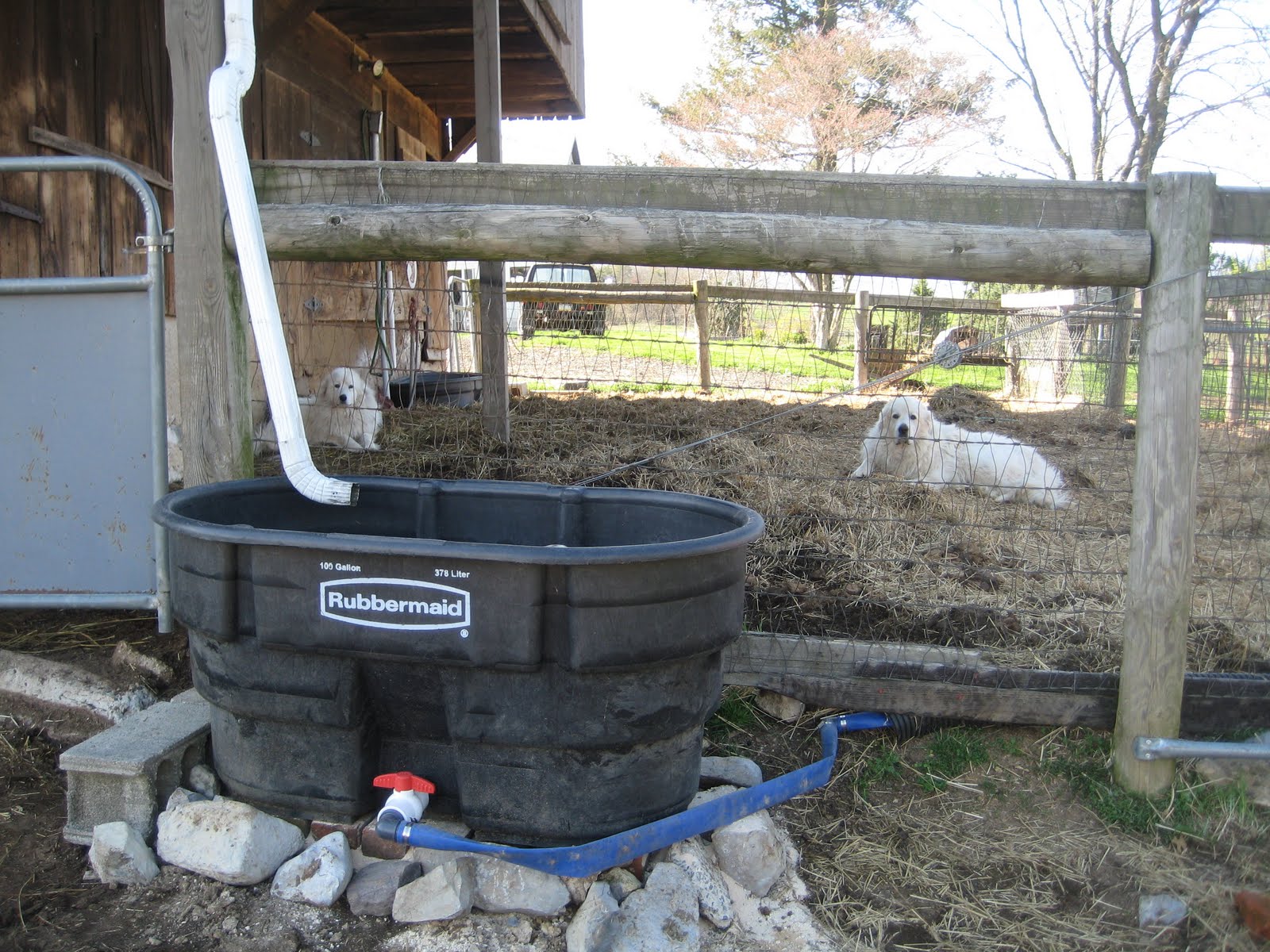 Now, just have to wait on those April showers scheduled for today to fill the tank. Next chore...giving all the downhill tanks a good scrubbing and checking their hoses & hardware, but I have to start from the top and work my way down.